






Can blood pressure medication increase your skin cancer risk?
Dermatologist reviewed: Jennifer Adams, MD, DTM&H, FAAD; Carrie Kovarik, MD, FAAD; John Trinidad, MD, MPH, FAAD. Reviewer bios.
Yes. Some studies suggest that taking certain blood pressure medications may slightly increase the risk of developing skin cancer. Keep in mind this risk is slight. It likely occurs because some of these medications make the skin more sensitive to the sun.

Sun protection can help reduce your risk of skin cancer while taking blood pressure medications.
Which blood pressure medications can increase skin cancer risk?
Many studies have looked at the association between taking certain blood pressure medications and developing skin cancer. Here’s what they’ve found:
Medication that contains hydrochlorothiazide may increase the risk: Studies have found that patients have a slight increased risk of developing skin cancer when they take this medication for many years.
The evidence from these studies was strong enough that the U.S. Food and Drug Administration (FDA) now requires information about this risk be included in the document that tells you about the medication and its use.
This added information advises patients to:
Protect their skin from the sun.
Get skin cancer exams.
Keep in mind that the researchers didn’t account for other known risks for skin cancer, such as whether the people in these studies had protected their skin from the sun or used tanning beds.
How do you know if your medication contains hydrochlorothiazide? You have a few options:
Ask your pharmacist or doctor.
Look at the prescription bottle or information that comes with your medication.
- If you’re taking a generic, you’ll see the word “hydrochlorothiazide.”
- Taking a brand name medication? You’ll see the brand name followed by (hydrochlorothiazide.) For example, you may see “Microzide (hydrochlorothiazide).”
- When a blood pressure prescription contains more than one active ingredient and one of these ingredients is hydrochlorothiazide, you’ll see the brand names followed by “HCT” or “HCTZ.” For example, you might see “Lotensin HCT.”
Do other blood pressure medications increase the risk of developing skin cancer? Researchers have found that other blood pressure medications might increase the risk of developing skin cancer. The findings from these studies are mixed. For example, one study may find an increased risk while another study does not.
Sometimes, the results from a study apply to a small group of people. For example, a study of more than 20,000 Swedish women found that the women who took a type of blood pressure medication called a loop diuretic had an increased risk of developing one type of skin cancer, squamous cell carcinoma.
Keep in mind that this study enrolled only Swedish women, so these results would need to be repeated in diverse peoples.
Which blood pressure medications include a warning about the risk of developing skin cancer?
The FDA requires this warning only for blood pressure medication that contains hydrochlorothiazide.
If additional studies continue to show an increased risk for any type of skin cancer, the FDA may add this warning to other blood pressure medications.
What do dermatologists recommend if you take blood pressure medication that can increase skin cancer risk?
Taking blood pressure medication helps to prevent a stroke or heart attack. This benefit greatly outweighs the slight increased risk of developing skin cancer.
For these reasons, dermatologists recommend the following:
Continue to take your blood pressure medication. If you stop taking your medication, your blood pressure can rise. This rise can increase your risk of having a life-threatening heart attack or stroke. By contrast, skin cancer is highly treatable when caught early and measures can be taken to reduce your risk of developing it.
Protect your skin from the sun. By protecting your skin from the sun, you can reduce the sun sensitivity that a medication may cause. Sun protection can also reduce your risk of developing skin cancer. To protect your skin, dermatologists recommend that you do all the following:
- Seek shade, especially when your shadow is shorter than you.
- Cover up with clothing that protects your skin from the sun. Wear pants, long sleeves, a wide-brimmed hat, and sunglasses that offer UV protection.
Some patients prefer to buy UPF clothing because it includes a rating that tells you how well the clothing protects your skin from the sun. If you prefer this option, dermatologists recommend buying clothing with UPF 30 or higher.
- Apply sunscreen to all skin that clothing doesn’t cover, using sunscreen with SPF 30, broad-spectrum protection, and water resistance. Using a sunscreen that offers all three helps to reduce your risk of developing skin cancer.
Talk with your dermatologist about your skin cancer concerns. Some people have a higher risk of developing skin cancer. Your dermatologist can tell you if you do.
For more information about what can increase your risk, go to:
Who gets skin cancer?
Keep all your dermatology appointments for skin exams. If skin exams are recommended, keeping appointments can help find skin cancer early when it’s highly treatable. Even the most serious skin cancer, melanoma, is highly treatable when found early and properly treated.
Never use indoor tanning. You may have heard that tanning beds and other indoor tanning equipment are safer than the sun. That’s a myth. Tanning beds and other indoor tanning equipment give off ultraviolet (UV) radiation, which is the leading cause of skin cancer. The amount of radiation produced during indoor tanning is similar to that of the sun, and in some cases may be stronger.
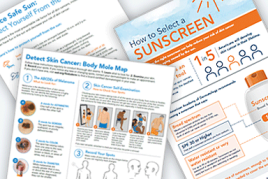
Perform skin self-exams. You can do this exam at home. Regularly examining your skin can help you find skin cancer early when it’s highly treatable.
How to perform a skin self-exam
Contact your dermatologist if you see anything on your skin that is growing, bleeding, or changing. These are common signs of skin cancer. When caught early, even melanoma (the most serious skin cancer) is highly treatable.
Although some blood pressure medications may slightly increase your risk of developing skin cancer, it’s important to keep taking this medication. Following the dermatologists’ advice in this article can reduce your risk of developing skin cancer and help you find skin cancer early when it’s highly treatable.
Related AAD resources
Skin cancer: Learn about symptoms, how skin cancer is diagnosed, and the causes.
Dermatologist reviewer bios
Jennifer L. Adams, MD, FAAD, DTM&H
Board certified in dermatology, Dr. Adams is renowned for her expertise in diagnosing and treating skin conditions, including:
Skin cancer
General medical skin disease and inflammatory skin disease
Skin issues caused by an infectious disease, such as HIV or a tropical disease
Her patients appreciate that she listens and takes time to thoroughly answer questions.
She is committed to helping people across Nebraska receive the specialized medical care they need to treat skin conditions and understands that people in rural areas cannot always travel to get this care. That’s why she led a program that brought this specialized care to them through telemedicine.
Dr. Adams sees patients in Omaha, Nebraska. At the UNMC in Omaha, she chairs the Department of Dermatology and is an Associate Professor of Dermatology.
Carrie L. Kovarik, MD, FAAD
Board certified in dermatology and dermatopathology, Dr. Kovarik is well known for her expertise and research in:
Treating hard-to-treat skin conditions due to infectious diseases
Using technology to help doctors and other health care providers get expert opinion on complex skin conditions
Diagnosing and treating skin-related side effects due to HIV or other immunosuppressive conditions
One of the first to use telemedicine, Dr. Kovarik created the Penn Dermatology Global Health program to provide care and education in underserved communities.
Dr. Kovarik sees patients in Philadelphia. Her practice is limited to patients who have a skin, hair, or nail condition that is difficult to diagnose, rare, or requires specialists in different fields. She teaches at the Hospital of the University of Pennsylvania, where she is Professor of Dermatology, Dermatopathology, and Infectious Diseases.
John Trinidad, MD, MPH, FAAD
Board certified in dermatology, Dr. Trinidad is known for his expertise in treating:
Aggressive skin cancers
Complex skin issues due to HIV/AIDS and other infectious diseases
People who face barriers to obtaining medical care for conditions that affect their skin, hair, or nails
Throughout this career, Dr. Trinidad has worked to improve access to dermatologic care for people who may have difficulty getting this care. He says, “Addressing such health disparities is at the core of my practice.”
In the Boston area, Dr. Trinidad sees patients from many different backgrounds. His patients say he is highly approachable and makes them feel seen and respected.
Dr. Trinidad teaches medical students and residents at Massachusetts General Hospital. He is also Director of Underserved Populations in the Department of Dermatology at Massachusetts General Hospital.
Written by Paula Ludmann, MS
Paula has more than 20 years of experience writing about skin, hair, and nail conditions for patients and the public.
She enjoys developing easy-to-understand information that people can use to make informed health decisions.
Paula’s passion for creating patient-first information has led to her work being mentioned by Prevention magazine and the Washington Post. She has won numerous awards, including Webbies, Apex Awards, and several awards from professional organizations.
References
American Academy of Dermatology. Indoor Tanning Fact Sheet. Last updated Feb 11, 2025. Last accessed Jul 17, 2026.
Chen C, Eworuke E, et al. “Use of hydrochlorothiazide in the United States following label update about skin cancer risk.” Pharmacoepidemiol Drug Saf. 2024 Oct;33(10):e70040.
Christensen GB, Kappelin J, et al. “Photosensitizing drugs and risk of skin cancer in women-A prospective population-based study.” Photodermatol Photoimmunol Photomed. 2025 Mar;41(2):e70013.
Heisel AGU, Vuurboom MD, et al. “The use of specific antihypertensive medication and skin cancer risk: A systematic review of the literature and meta-analysis.” Vascul Pharmacol. 2023 Jun;150:107173.
Nochaiwong S, Chuamanochan M, et al. “Use of thiazide diuretics and risk of all types of skin cancers: An updated systematic review and meta-analysis.” Cancers (Basel). 2022 May 23;14(10):2566.
Image credit
Getty Images